-
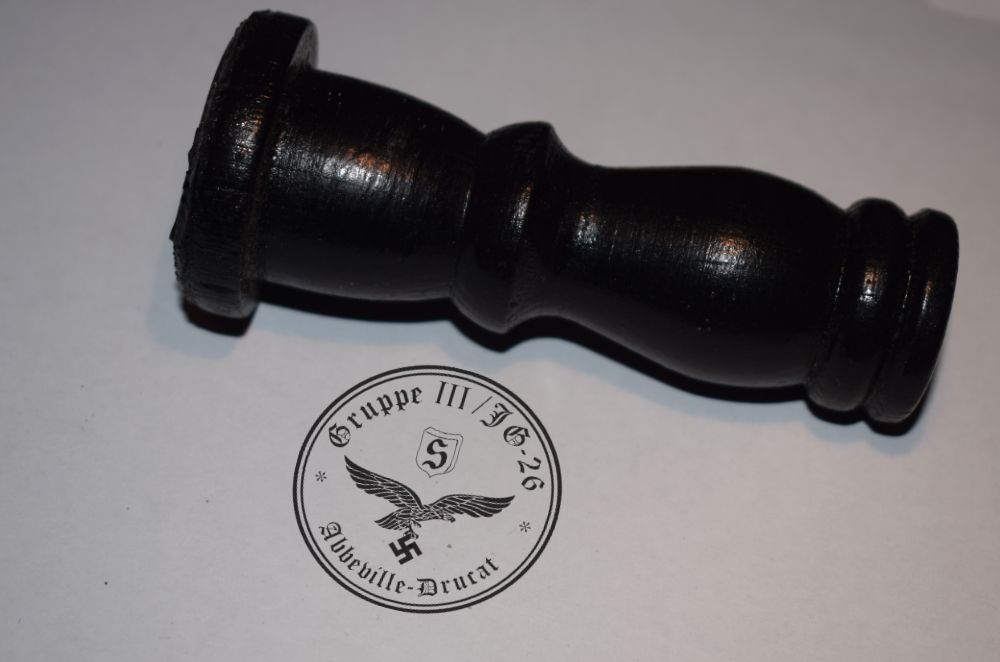
Luftwaffe Abbevile-Drucat JG26 Rubber Stamp
- Traditional wooden handled rubber stamp
- £19.95
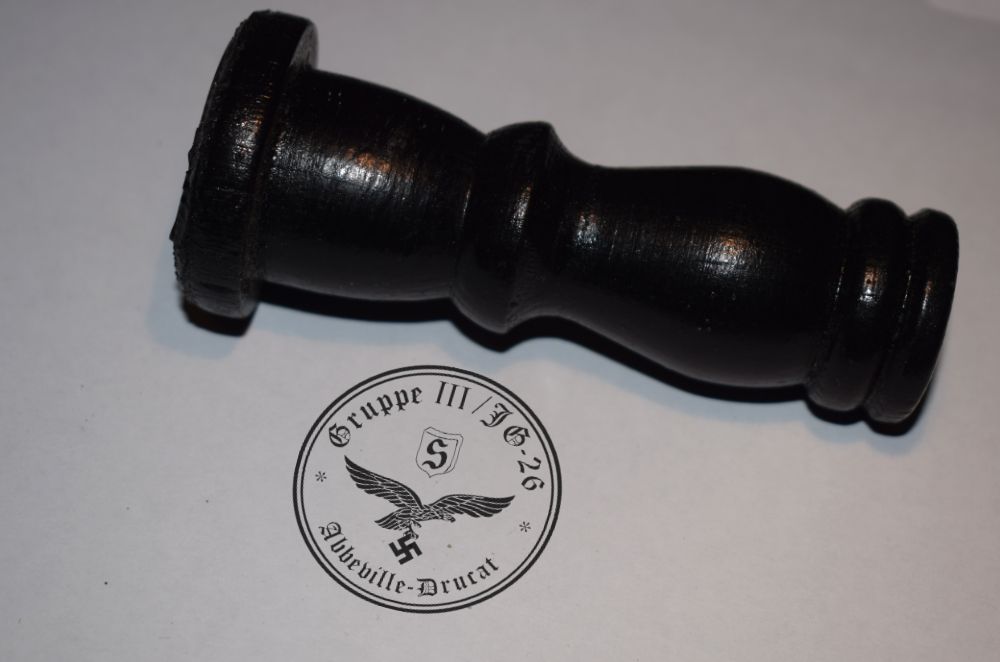
Luftwaffe Abbevile-Drucat JG26 rubber stamp
JG 26 took part in the Battle of France from 10 May 1940 onwards, flying the Messerschmitt Bf 109 fighter. To help with identification the unit had the undernoses of their aircraft painted yellow. Some aircraft had their entire cowling thus painted. JG 26 claimed 160 French and British aircraft shot down, for relatively light losses of 17 pilots killed. After the fall of France JG 26 took part in the Battle of Britain, based in the Pas de Calais region. In late August it was becoming apparent to the German High Command that the Battle of Britain was not going as planned. A frustrated Göring relieved several Geschwaderkommodoren of their commands, and appointed younger, more aggressive men in their place. Thus Major Adolf Galland was given command of JG 26 on 22 August. During the Battle of Britain, the Geschwader claimed 285 fighters shot down, for losses of 76 aircraft and 45 pilots killed, and 29 prisoners of war.
In 1941 most of the fighter units of the Luftwaffe were sent east to the Eastern Front, or south to the Mediterranean Theater of Operations, thus leaving JG 26 and Jagdgeschwader 2 Richthofen as the sole single-engine fighter Geschwadern in France. For the next two years these two Geschwadern were the main adversaries to the Royal Air Force's (RAF) day offensives over Occupied Europe. The two Jagdgeschwader maintained around 120 serviceable Bf 109 E and F's to face the increasing number of aggressive RAF Fighter Command sweeps conducted to wear down the Luftwaffe in a war of attrition and so relieve pressure on the Eastern Front.
Galland's careful husbanding of his resources and astute tactical awareness meant JG 26 kept their losses to a minimum while inflicting maximum damage on the RAF's Spitfires through 1941. This became even more evident with the arrival of the potent Focke-Wulf Fw 190A to units in late 1941 - early 1942, which, in most cases, outclassed the current Spitfire Mark Vb in service with the RAF. In late 1941 JG 26 started converting to the Fw 190A fighter. I. and II. Gruppe were soon fully equipped with this aircraft, and although the III Gruppe started converting, the process was stopped and it continued using various versions of the Bf 109 for the remainder of the war. By the end of 1941 JG 26 had claimed more than 900 victories since September 1939 (some 400 since May 1941), and had lost some 95 pilots killed (34 POW) in return. The highest scoring pilots at this time were Galland (97), Hptm Muncheberg (62) and Hptm Josef Priller (58).
JG 26 and Jagdgeschwader 2 (JG 2) had to defend the entire Atlantic Wall from the Spanish border through Belgium, until late 1942 when more units were directed West after the Allied bombing campaigns increased in ferocity.
The Abbeville boys
Although JG 26 was not known by specific name to their opponents, JG 26 built a fearsome reputation among Allied aircrews. The skill and determination of the Luftwaffe fighter units when attacking United States Army Air Forces (USAAF) bomber formations led the Allied bomber crews to become wary whenever any yellow-nosed Bf 109 or Fw 190 aircraft attacked them. Because some elements of the unit was based in Abbeville-Drucat the Allies dubbed any yellow-nosed Bf 109 or Fw 190 aircraft who aggressively and effectively attacked them the nickname The Abbeville Boys and perceived them as the Luftwaffe's special hand-picked elite group of aces, although from the Luftwaffe's perspective they were just another'albeit highly experienced and effective'fighter Geschwader.