-
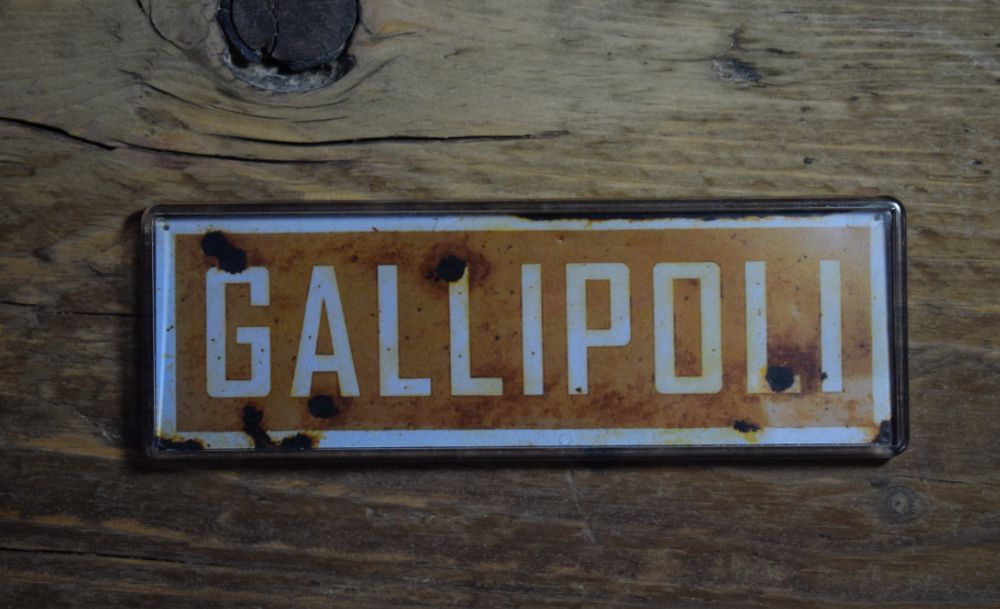
Gallipoli Fridge Magnet
- 147mm x 50mm Fridge Magnet
- £2.99
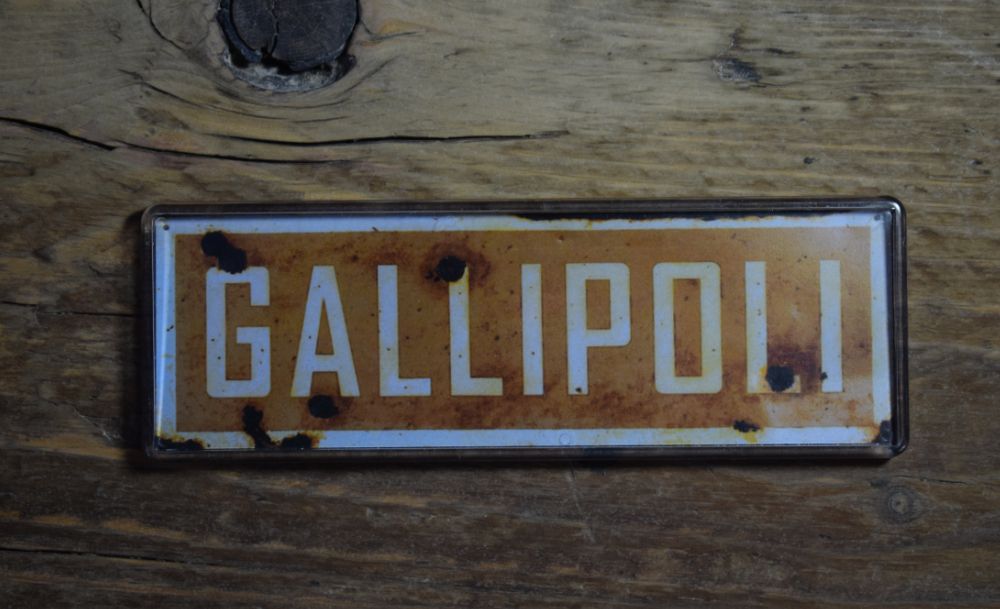
Gallipoli. 147mm x 50mm Fridge Magnet
During World War I (1914-1918), French, British and allied forces (Australian, New Zealand, Newfoundland, Irish and Indian) fought the Gallipoli campaign (1915-1916) in and near the peninsula, seeking to secure a sea route to relieve their eastern ally, Russia. The Ottomans set up defensive fortifications along the peninsula and contained the invading forces.
In early 1915, attempting to seize a strategic advantage in World War I by capturing Istanbul (formerly Constantinople), the British authorised an attack on the peninsula by French, British and British Empire forces. The first Australian troops landed at ANZAC Cove early in the morning of 25 April 1915. After eight months of heavy fighting the last Allied soldiers withdrew by 9 January 1916.
The campaign, one of the greatest Ottoman victories during the war, is considered by historians as a major Allied failure. Turks regard it as a defining moment in their nation's history: a final surge in the defence of the motherland as the Ottoman Empire crumbled. The struggle formed the basis for the Turkish War of Independence[citation needed] and the founding of the Republic of Turkey eight years later under President Mustafa Kemal Atatürk, who first rose to prominence as a commander at Gallipoli.
The Ottoman Empire instituted the Gallipoli Star as a military decoration in 1915 and awarded it throughout the rest of World War I.
The campaign was the first major military action of Australia and New Zealand (or Anzacs) as independent dominions. The date of the landing, 25 April, is known as "Anzac Day". It remains the most significant commemoration of military casualties and "returned soldiers" in Australia and New Zealand.
On the Allied side one of the promoters of the expedition was Britain's First Lord of the Admiralty, Winston Churchill, whose bullish optimism caused damage to his reputation that took years to repair.
Whilst the underlying strategic concept of the campaign was sound the military forces of the WW1 lacked the logistical, technological and tactical capabilities to undertake an operation of this scope against a determined, well equipped defender.
The all arms coordination and logistical capabilities required to successfully prosecute such a campaign would only be achieved three decades later, during the successful Allied amphibious invasions of Europe and the Pacific during WW2.
Prior to the Allied landings in April 1915, the Ottoman Empire deported Greek residents from Gallipoli and surrounding region and from the islands in the sea of Marmara, to the interior where they were at the mercy of hostile Turks. The Greeks had little time to pack and the Ottoman authorities permitted them to take only some bedding and the rest was handed over to the Government. The Turks then plundered the houses and properties. A testimony of a deportee described how the deportees were forced onto crowded steamers, standing-room only then on disembarking, men of military age were removed (for forced labour in the labour battalions of the Ottoman army.) The rest were "scattered… among the farms like ownerless cattle.
The Metropolitan of Gallipoli wrote on 17 July 1915 that the extermination of the Christian refugees was methodical. He also mentions that "The Turks, like beasts of prey, immediately plundered all the Christians' property and carried it off. The inhabitants and refugees of my district are entirely without shelter, awaiting to be sent no one knows where ...". Many Greeks died from hunger and there were frequent cases of rape among women and young girls, as well as their forced conversion to Islam. In some cases, Muhacirs appeared in the villages even before the Greek inhabitants deported and stoned the houses and threatened the inhabitants that they would kill them if they did not leave.